
We welcome Sofia Hennig as Chief Marketing Officer
As part of our long-term commitment to continued growth, Sofia Hennig has joined us as CMO.
In this role, Sofia will lead and further develop the company's

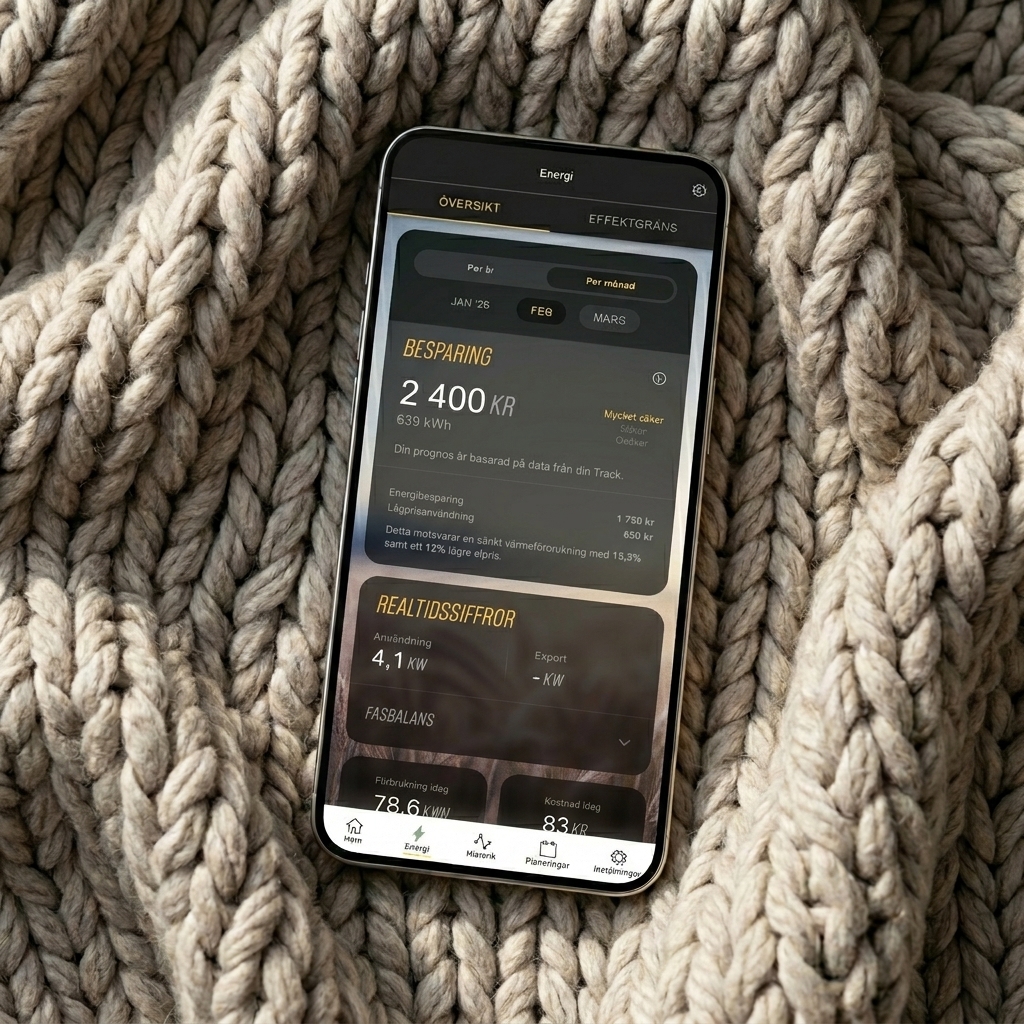
Ngenic Energi is now launching an updated version of its Tune app with two highly requested features: a new model for calculating actual energy savings and a tool for automatic power limiting.
Individual Calculation of Energy Savings
The new savings estimate is customized for each home that has a Track connected. Track is Ngenic’s solution for measuring energy consumption via the electricity meter’s P1 port or through optical reading withNgenicTrack Opto. By analyzing how the home responds to outdoor temperatures and how the control system affects energy usage, the system can compare consumption with and without optimization—under the same weather conditions.
The result is presented as an estimate in both kilowatt-hours and Swedish kronor, along with a confidence interval that indicates how reliable the calculation is.
Requires real-time data from Track

The feature is initially available to users with the Ngenic TrackHANorNgenicTrackOpto real-time meter,which provides the system with detailed data.
In May, the first integration with another “electricity meter dongle” will be released, and in the future, support will be added for more brands be expanded.
For those users without Track or another compatible browser , a simpler cost-saving calculator be launched 26 May.
New Feature Aims to Reduce Power Peaks
At the same time, a new power-limiting feature is being introduced. It allows users to set a cap on their household’s power consumption during specific times.

If the system predicts that consumption is likely to exceed the limit, the heat pump automatically adjusts to avoid high power peaks.
Adapted to a Changing Electricity Market
The background to this is the power-of-use tariffs that an increasing number of electric utility companies have introduced, in which the cost is based on peak power consumption rather than total energy consumption. Although the requirement for mandatory power-of-use tariffs was recently withdrawn in Sweden, trends within the EU suggest that this model will become more common in the future.
The power limit is included in Ngenics' Standard and Premium subscriptions.
As part of our long-term commitment to continued growth, Sofia Hennig has joined us as CMO.
In this role, Sofia will lead and further develop the company's

Ngenic Energi continues its focus on smart energy solutions for Swedish households. On September 1, Olle Lindbom will take office as the new CEO of Ngenic Energi and assume
Ngenic Energi and Bitvis have integrated Ngenic Tune into the Bitvis platform, enabling energy companies to offer smart heating control to homeowners through their

Sala Heby Energi is relaunching its Smart Värme service, which allows residents of Sala and Heby to rent or use existing Ngenic equipment through a monthly subscription model. The system