How much can Swedish homeowners actually save with smart heating control?
A new study by Ngenic Energi, conducted in collaboration with a Swedish energy company, shows that the potential is even greater than previously thought.
The study was conducted in a residential neighborhood where all the houses have similar construction, were built in the same year, and are heated by district heating.
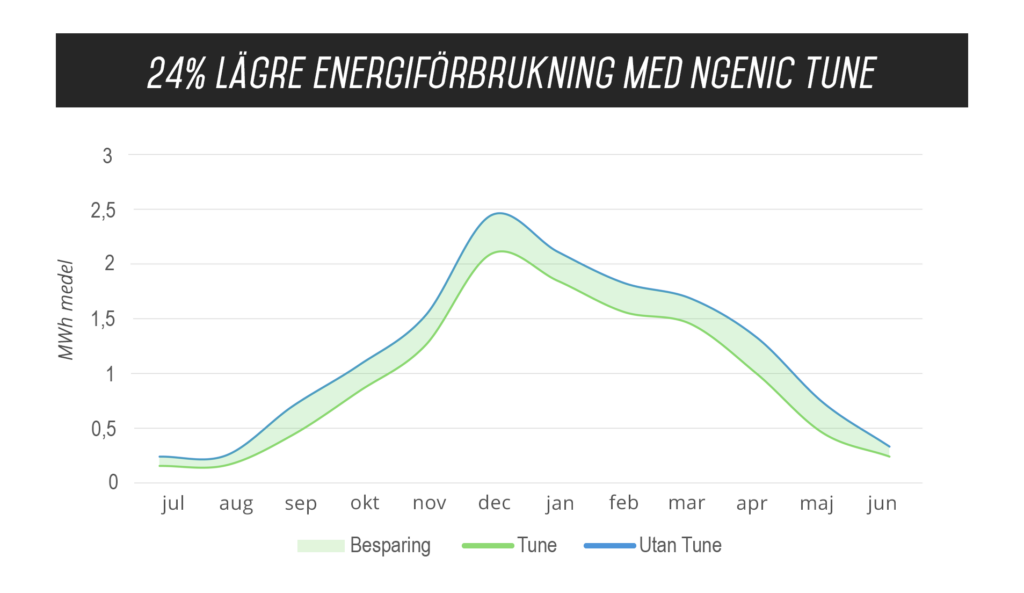
Instead of comparing energy consumption before and after installation—as is often done in this type of study—the researchers chose to compare similar homes with and without Ngenic Tune installed.
Homes equipped with Ngenic Tune used, on average, 24% less energy for heating than neighboring homes without smart control systems.
That amounts to approximately 2,700 kWh per household per year—without any negative impact on comfort. On the contrary, many people experienced a more consistent and pleasant indoor climate.
Based on the average district heating price of 1,200 SEK/MWh (a 9% increase over the past year), the savings amount to approximately 3,200 SEK per single-family home per year.
Electricity transmission fees have also risen, by about 11%—which underscores the importance of using the energy we already consume more efficiently.
According to the Nils Holgersson Report 2025 , it is highly unlikely that energy prices will fall in the near future. Therefore, solutions like Ngenic Tune offer households a practical way to cope with rising costs.
Energy efficiency isn't justabout economics.
Reduced energy consumption also means reduced greenhouse gas emissions. In Sweden, carbon dioxide emissions from district heating amount to approximately 115 g CO₂ per kWh (source: Energiföretagen).
If the equivalent reduction—24%—were achieved across the entire Swedish single-family home stock using district heating, nearly 100,000 metric tons of carbon dioxide could be avoided each year. This corresponds to a reduction in the energy sector’s total emissions in 2024 of approximately 2.5%.
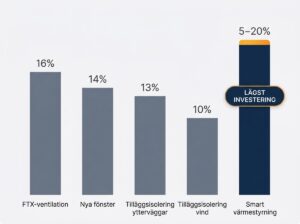
Heating and hot water account for about 75% of energy use in Swedish single-family homes (source: SCB). Optimizing how that energy is used is therefore one of the most effective ways to reduce both costs and the carbon footprint.
With Ngenic Tune, homeowners get a system that automatically learns how their home responds to weather and temperature—and adjusts the heating accordingly. The result is a home that’s smarter, more comfortable, and more sustainable.