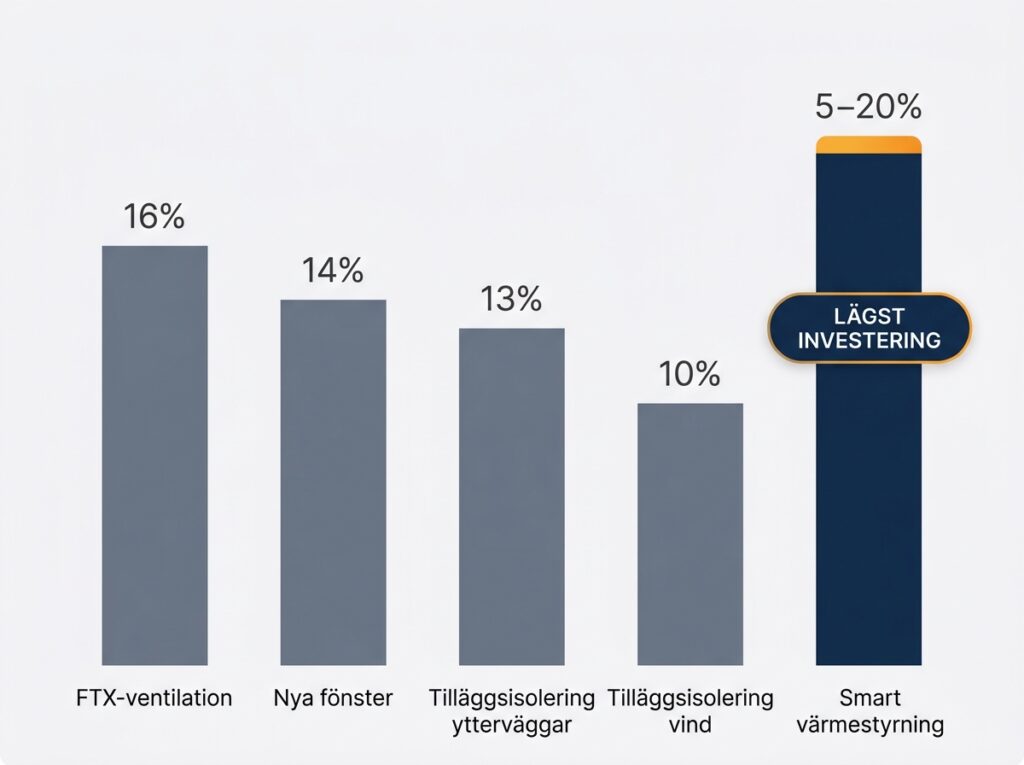
The Swedish Energy Agency identifies control and regulation as one of the most cost-effective measures for reducing energy consumption in homes
Summer is peak season for renovations and energy efficiency improvements. Many homeowners are planning to replace windows, add insulation, or take other steps to reduce energy consumption and lower energy costs in preparation for next winter.
| Action |
Annual savings as a percentage
(the building's energy needs) |
| Additional Insulation for Exterior Walls |
13 % |
| Additional Insulation for the Attic |
10 % |
| Replace windows with ones that have a lower U-value |
14 % |
| Switch from mechanical exhaust ventilation to mechanical exhaust and supply ventilation with heat recovery (FTX) |
16 % |
| Switch to High-Efficiency Faucets |
8 % |
| Installation of Heating Control and Regulation Systems |
5–20%
(the savings are greater with hydronic heating and lower with direct-acting electric heating) |
| Replacing Radiator Thermostats (Radiator Elements) |
4 % |
However, according to the Swedish Energy Agency’s summary of energy efficiency measures, there is one measure that often yields greater energy savings at a significantly lower cost: optimizing a building’s control and regulation systems.
Examples of savings from these measures
The potential for reducing energy consumption through smart heating control is estimated at about 20 percent. This makes it one of the most effective ways for homeowners to improve their home’s energy efficiency.
For anyone considering energy efficiency measures, this raises an important question: Is it really the right approach to start with the most expensive investments?
Studies show lower energy consumption in single-family homes with smart heating control
The results are consistent with the analyses conducted by Ngenic Energi in recent years.
A study of single-family homes using Ngenic Tune showed that households with the service had 24 percent lower energy consumption than comparable homes without optimization. At the same time, analyses of more than 15,000 Swedish homes have shown that smart heating control not only reduces energy use but also contributes to a more consistent indoor temperature and increased comfort.
To make a house more energy-efficient, you need to follow the right steps
There is another aspect that is often overlooked when homeowners plan energy-efficiency improvements.
When a house is retrofitted with additional insulation or new energy-efficient windows, its heating requirements change. If the heating system is not adapted to the new conditions, some of the expected energy savings may not be realized.
The result may be higher indoor temperatures and greater comfort—but not necessarily lower energy consumption or lower heating costs.
Therefore, optimizing control and regulation can be viewed as a fundamental prerequisite for other energy-efficiency measures to achieve maximum effectiveness.
Greatest energy savings per krona invested
Many traditional energy-efficiency measures for single-family homes involve investments of tens of thousands or hundreds of thousands of kronor.
Smart heating control, on the other hand, requires significantly less capital, while the potential savings can be comparable or even greater.
For homeowners who want to maximize energy savings and lower their energy costs, the strategy is therefore clear:
- Optimize the heating system and heating control.
- Determine the house's actual energy needs.
- Next, make larger investments, such as adding insulation or replacing windows.
An optimized heating system also makes it easier to ensure that future investments continue to deliver results over time.
A Smart First Step Toward Lower Energy Costs
It's hard to know how cold next winter will be. But experience shows that improving energy efficiency always pays off in the long run.
For many homeowners, the most cost-effective first step may therefore be much simpler than one might think: optimizing the heat that is already being produced.
When the heating system operates more efficiently, it also becomes easier to reduce energy consumption, lower energy costs, and get the most out of future investments in the home.